The room
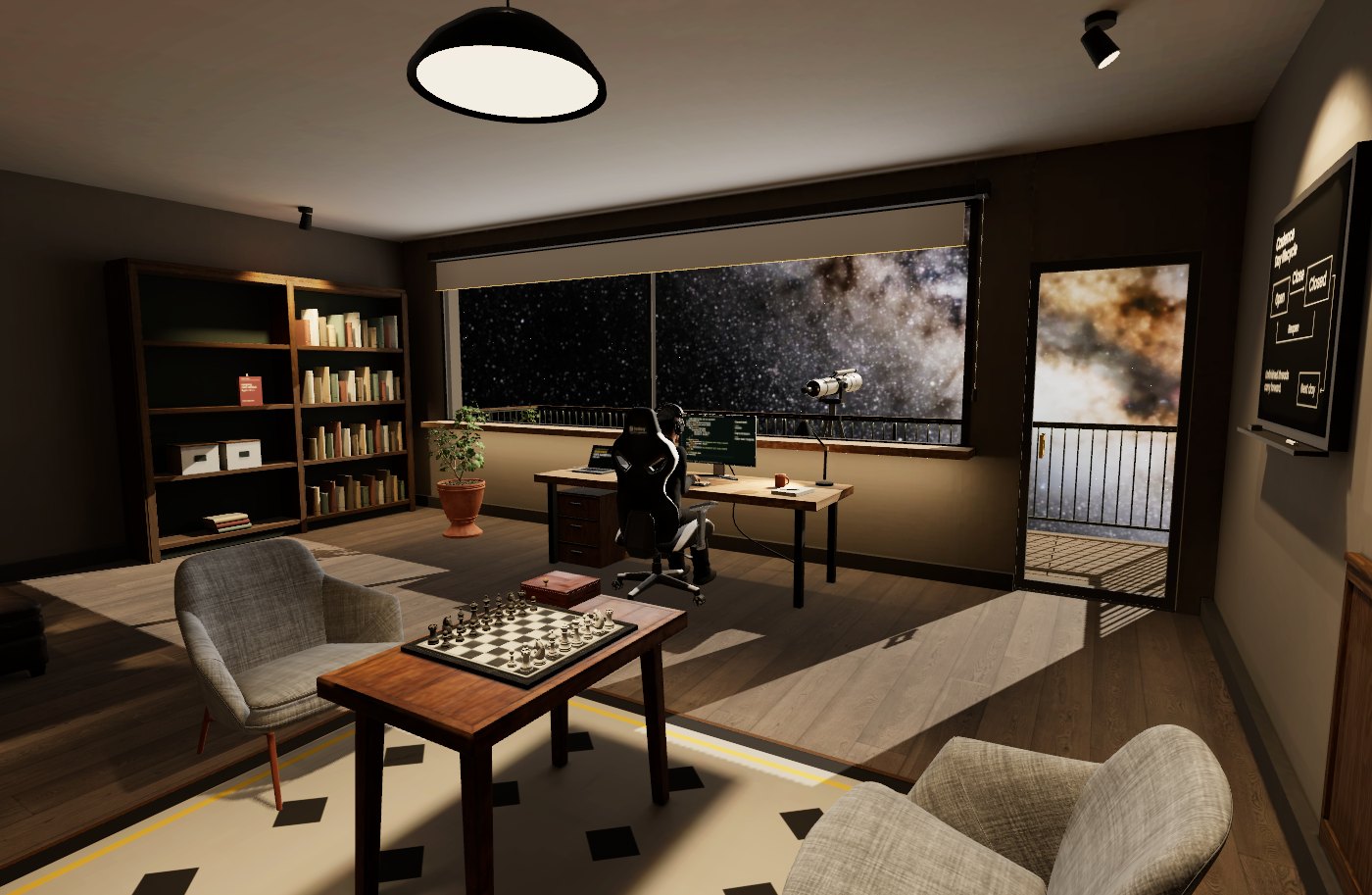
A room for work, chess, and reading.
A room to step into
Take a seat at the chessboard, pick up a book, or step outside to the telescope.
Explore the objects and their links below.
In the room
- The deskLevorofit
Read the current work: at kognos infosystem, working on levorofit, a crm product for nutritionists.
The monitor types real code as he works: Cadence’s day service on GitHub
- The folio
The professional record: roles, projects, skills, education, and contact. The complete record is linked below.
- The door
The terrace door opens onto the observation deck and telescope. The entrance door opens onto a landing with his GitHub, LinkedIn, email and résumé. You can return to the page from Pause.
- The window
An imagined room in deep space, surrounded by real ESO photographs of the Milky Way. From the window or the terrace rail you can fly the room to a planet; left alone, it floats free, turning under a rising and setting Sun as dust, worlds, spacecraft and asteroids drift past.
- The lamp
Warm lamps light the desk, books and chess table. The room dimmer changes the lamps while the sky stays unchanged.
- The chess board
Play White against the computer. Start a new game or leave the table whenever you like.
- The bookshelf
One is being read: Designing Data-Intensive Applications, by Martin Kleppmann. Books that have earned a place in the room. Pull one out and the rest keep their titles to themselves.
- The telescope
Aim and zoom through the Milky Way to find nebulae, star clusters and stars, each with an ESO archive photograph. It also names a world, spacecraft or asteroid in its view.
- The notebook
A notebook and pen on the desk. Pick up the current book from the reading shelf.
- The whiteboard
A diagram of Cadence’s day lifecycle: days can close and reopen, while unfinished threads carry forward to the next day.
- The chair
A desk chair faces the computer. Two upholstered chairs face each other across the chess table.
- The mug
A ceramic mug beside the keyboard.
- The plant
A potted plant beside the window.
- Loose papers
Two loose sheets beside the laptop.
Into his mind
From the lounge chair, or by looking into his eyes, his thoughts drift through the room as constellations.
Code
- A day is a row with a status. In Cadence a day is one row: open until it closes, and allowed to open again. I like how much meaning one small field can carry. Cadence, days/service.py
- Consent is a default, not a setting. Cadence keeps AI reviews off until you say yes. I think the state you start in should be the safe one. Cadence README
- A record of a life belongs to the person living it. Cadence is self-hosted. Habits and an hourly log are a diary, so they stay on a machine their owner controls. That is the point of building it that way. Cadence README
- What does it take for data to stay true when machines disagree? The question running through the book on my shelf, Designing Data-Intensive Applications by Martin Kleppmann. Every answer is a trade-off, and I like that it never pretends otherwise.
- Never use a long word where a short one will do. George Orwell’s rule for prose. I read it as a rule for code too: the clear name beats the clever one. George Orwell, Politics and the English Language (1946)
- Rewrite a program one file at a time. Is it still the same program? The Ship of Theseus, in a codebase. Plutarch asked it of a ship whose planks were replaced one by one; it comes back to me whenever an old system is rebuilt in place. The Ship of Theseus
Time
- Write where each hour went. Cadence asks one thing of every hour: where did it go? Not a judgement, a record. I find the honest answer more useful than the flattering one. Cadence README
- A closed day can open again. Closing a day is a decision, not a verdict. If something was missed, the day reopens; I would rather correct the record than pretend.
- Unfinished threads carry forward. What is not done today has not failed. It continues tomorrow, and tomorrow knows about it.
- A week is for reading back, not only for living. History exists in Cadence so the week can be seen whole: the habits kept, the hours spent, the days that closed. Cadence README
Astronomy
- Looking out is looking back. The Lagoon Nebula is about 5,000 light-years away, so the light reaching the telescope tonight left it around 3000 BCE. Every glance up is a glance into the past. ESO: the Lagoon Nebula
- Apart from hydrogen, almost every atom in you was made inside a star. The carbon in my cells, the oxygen I breathe, the iron in my blood: forged in stars, and scattered when they died, long before the Sun formed. Nucleosynthesis
- Antares is about seven hundred Suns wide. A red supergiant in Scorpius. Put it where the Sun is and its surface would reach past the orbit of Mars. I cannot hold a size like that in my head, and I like trying. ESO: Antares
- The centre of our galaxy hides behind dust. In visible light the middle of the Milky Way is dark. In infrared, the stars crowding around Sagittarius A*, a black hole of about four million Suns, come through. ESO: the Galactic Centre
- Some gaps in the stars are not gaps. Barnard 59 looks like a hole in the sky. It is a cloud of dust in front of the stars, and new stars are forming inside it. ESO: Barnard 59
- Near a black hole, time runs slow. Gravity bends time as well as light: a clock close to a black hole ticks slower than one far away. That this is simply true still astonishes me. Gravitational time dilation
- All of written history fits in the last dozen seconds of the year. The universe is about 13.8 billion years old. Squeeze its history into one calendar year and everything humans have ever written down happens in the final seconds of New Year’s Eve. The Cosmic Calendar
- More stars than grains of sand. By most estimates, the observable universe holds more stars than there are grains of sand on all of Earth’s beaches. I find that humbling, and oddly comforting.
Philosophy
- I think, therefore I am. Doubt everything you could be wrong about and one thing is left standing: the doubting itself. I find it steadying that certainty starts from doubt. René Descartes, Discourse on the Method (1637)
- All men by nature desire to know. The first line of Aristotle’s Metaphysics. Curiosity, for him, was not a hobby but part of what we are. This room is my evidence. Aristotle, Metaphysics, Book I
- We become just by doing just acts. Aristotle’s answer to how character forms: by practice, the way a builder becomes one by building. It is the oldest argument I know for keeping habits. Aristotle, Nicomachean Ethics, Book II
- Somewhere, chemistry started copying itself. Life began when molecules began making copies of themselves, around four billion years ago. Nobody knows exactly how. I like that the biggest question about us is still open. Abiogenesis
- The ego is a negotiator. In Freud’s picture the id wants, the superego forbids, and the ego negotiates between them and the world. Whatever you make of Freud, I recognise the negotiation. Id, ego and superego
- From six billion kilometres, Earth is less than a pixel. In 1990 Voyager 1 turned back and photographed Earth as a pale blue dot, smaller than a single pixel. Everything anyone has ever argued about happened on it. We are that small, and still we spend so much on appearances. The Pale Blue Dot
- Who controls the past controls the future. From Orwell’s Nineteen Eighty-Four: “Who controls the past controls the future: who controls the present controls the past.” A record that can be quietly rewritten is a kind of power. George Orwell, Nineteen Eighty-Four (1949)
Hip hop
- A mind can be a house you walk through. NF’s “Mansion” (featuring Fleurie) turns a mind into a house, room after room. The imagery takes me somewhere else entirely. This room is my attempt at the same idea. NF, Mansion (2015)
- Being stuck can be loud on the inside. “Paralyzed”, also on Mansion, sounds like being frozen inside your own head while everything else keeps moving. Few songs describe that feeling so plainly. NF, Mansion (2015)
- Disappointing someone you love is its own weight. “Let You Down” is about exactly that, and it does not try to look tough while saying it. NF, Perception (2017)
- Some searches are the point. “The Search” is restlessness turned into motion: looking for peace, and writing the whole way there. NF, The Search (2019)
- Technique is how a feeling gets through. “Intro III”, “Grindin’” (featuring Marty of Social Club) and “Lost” (featuring Hopsin): breath control, internal rhymes, syllables packed tight and then let go. The skill is never the point; it is what carries the point. NF discography
- Hope is a decision, not a mood. “Hope” (featuring Tommee Profitt), the title track of his 2023 album. After years of songs fighting his own head, he named the thing to stand on. NF, Hope (2023)
- A flow is a decision about where the syllables land. Cadence, in rap, is the rhythm of the words against the beat: on it, ahead of it, dragging behind it. Move a line into a different pocket and the same words mean something new.
- Writing it down turns a feeling into a shape. Bars, journals, an hourly log: different forms of the same act. Once a thought is on the page I can look at it instead of living inside it.
Psychology
- We rarely choose; we compare. Dan Ariely’s decoy: add a third option nobody wants and it quietly changes which of the other two people pick. I try to notice the decoy before it notices me. Dan Ariely, Predictably Irrational (2008)
- Free is not a price; it is a feeling. Another of Ariely’s experiments: a cent’s difference barely moves people, but making one option free moves almost everyone, even toward the worse one. Zero is not just another number to us. Dan Ariely, Predictably Irrational (2008)
- If a machine answers in perfect Chinese, does it understand Chinese? John Searle’s Chinese room (1980): a person follows rules to answer questions in a language they cannot read. It comes back to me whenever an AI sounds as if it understands. The Chinese room
- The numbers stay the same; something else changes. Philippa Foot’s trolley problem: divert a runaway trolley to kill one instead of five? Most people say yes, until, in Judith Jarvis Thomson’s version, the one must be pushed. The arithmetic is identical. We are not. The trolley problem
- A thought is not a fact. A thought can arrive loudly and still be wrong. Noticing it, rather than obeying it, is already a step back from it.
- Rest is part of the work. A tired mind solves the wrong problem with confidence. Stopping is not quitting; it is maintenance.
- Saying it out loud makes it smaller. Things kept inside tend to grow. Writing them down, or telling one person, gives them edges. NF made a career of saying it out loud.
Poetry
- The Brain—is wider than the Sky— The Brain—is wider than the Sky— For—put them side by side— The one the other will contain With ease—and You—beside— The Brain is deeper than the sea— For—hold them—Blue to Blue— The one the other will absorb— As Sponges—Buckets—do— The Brain is just the weight of God— For—Heft them—Pound for Pound— And they will differ—if they do— As Syllable from Sound— I come back to it whenever I look up: the mind that holds the sky is wider than it.Emily Dickinson, c. 1862
- Look’d up in perfect silence at the stars. When I heard the learn’d astronomer, When the proofs, the figures, were ranged in columns before me, When I was shown the charts and diagrams, to add, divide, and measure them, When I sitting heard the astronomer where he lectured with much applause in the lecture-room, How soon unaccountable I became tired and sick, Till rising and gliding out I wander’d off by myself, In the mystical moist night-air, and from time to time, Look’d up in perfect silence at the stars. The figures matter to me, and so does the moment you stop measuring and simply look. Walt Whitman, Leaves of Grass
- To see a World in a Grain of Sand To see a World in a Grain of Sand And a Heaven in a Wild Flower Hold Infinity in the palm of your hand And Eternity in an hour The smallest thing, looked at properly, opens onto everything. William Blake, Auguries of Innocence
- Where the mind is without fear Where the mind is without fear and the head is held high; Where knowledge is free; Where the world has not been broken up into fragments by narrow domestic walls; Where words come out from the depth of truth; Where tireless striving stretches its arms towards perfection; Where the clear stream of reason has not lost its way into the dreary desert sand of dead habit; Where the mind is led forward by thee into ever-widening thought and action— Into that heaven of freedom, my Father, let my country awake. Tagore wrote this English himself. A prayer for a country that is really a description of a free mind. Rabindranath Tagore, Gitanjali 35 (1912)
- Bright star, would I were stedfast as thou art Bright star, would I were stedfast as thou art— Not in lone splendour hung aloft the night And watching, with eternal lids apart, Like nature’s patient, sleepless Eremite, Even the steadiest-looking star is a furnace burning out. Keats wanted its stillness anyway, and I understand why. John Keats, c. 1819
Chess
- A move is a question the board answers. Every move proposes something about the position. The reply tells me whether I was right.
- Play the position, not the hope. The board shows everything. What I wish were there is not a move.
Credits
- Hands: Elena FF · adapted, CC BY-SA 4.0
- Sky: ESO/S. Brunier · CC BY 4.0
- Detail: ESO/S. Guisard · CC BY 4.0 · Image licenses and adaptations
- People and their motion: Microsoft Rocketbox avatars and motion capture · MIT
- His headphones: based on "Sony MDR-7506 Headphones" by AndreiVNK · CC BY 4.0
- Telescope archive photographs: ESO · CC BY 4.0
- Planet maps: Solar System Scope, based on NASA imagery (CC BY 4.0) · Adaptations
- Spacecraft and asteroid models: NASA 3D Resources · Adaptations
- Chess set by Riley Queen, published by Poly Haven · CC0 1.0